Website Redesign for Global Trucking Company
Redesigning a 19-market enterprise website during a full CMS migration requires more than visual polish. It demands system thinking, stakeholder alignment, and UX decisions that scale globally.
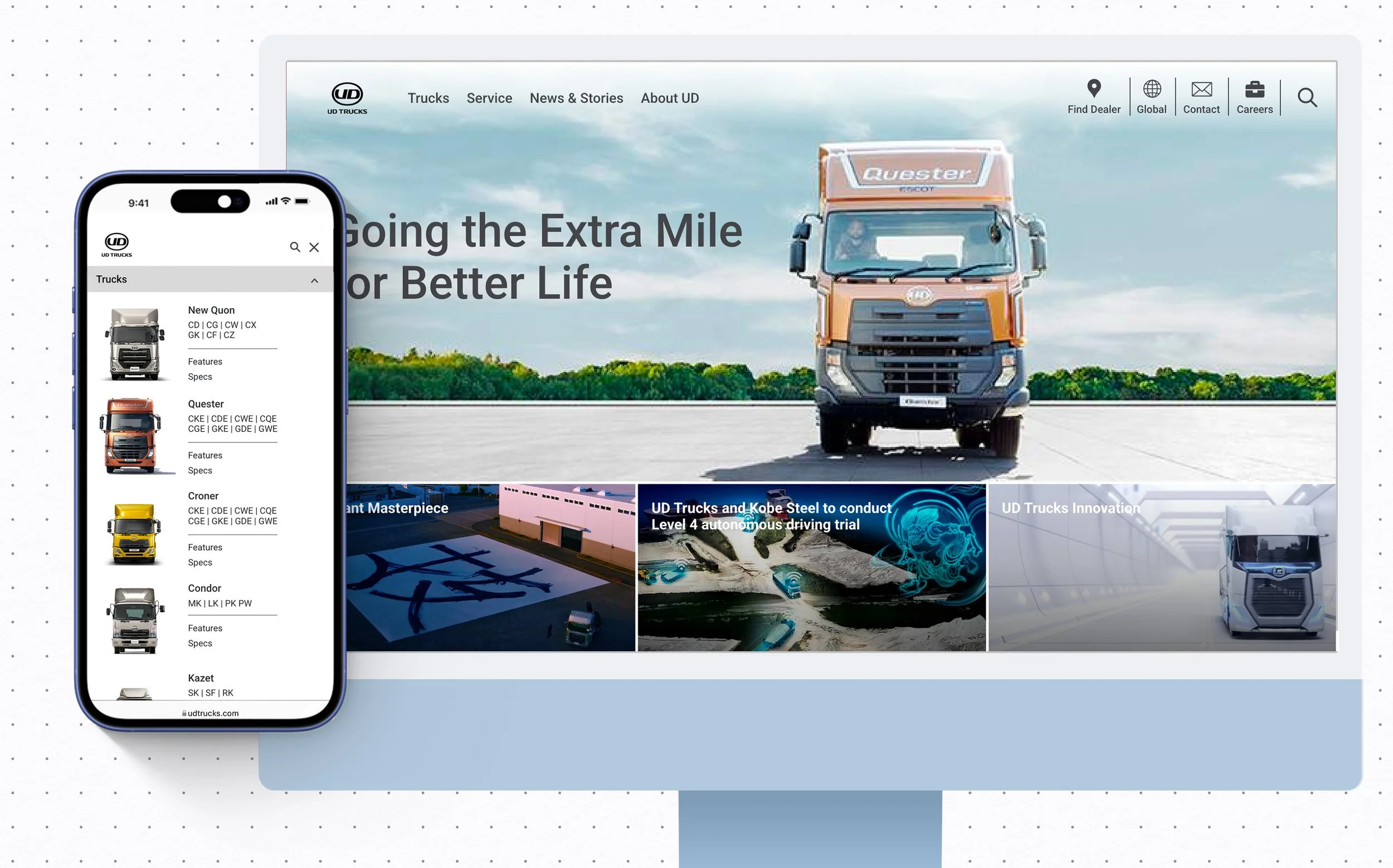
As Lead UX/UI Designer, I drove the experience strategy and interface design for a global trucking brand transitioning from Sitecore to Drupal, working alongside project managers, developers, and regional stakeholders to unify design, structure, and usability across markets.
The Challenge
The existing global website struggled on three levels:
1. Experience fragmentation
Each market operated with inconsistent layouts, styling, and navigation patterns, resulting in a disjointed user experience across regions. Countries like Japan looked different than those in the Middle East or U.S., which in turn affected brand perception.
2. CMS friction for internal teams
Sitecore’s complexity made content updates difficult for regional teams, slowing workflows and discouraging ownership.
3. Scale without cohesion
With 19 markets and multiple stakeholder groups, there was no shared design language or system to support future growth.
The Solution
Rather than treating the redesign as a visual refresh, we approached it as a system rebuild.
My focus was defining a scalable UX/UI foundation that could:
Support a modular, component-based CMS
Reduce friction for internal content teams
Maintain consistency while allowing regional flexibility
Improving interactive features such as their Dealer Locator (with over 500+ locations worldwide), along with Truck Compare feature — benchmarking internal feedback to auto industry tools.
Working closely with project managers and developers, I translated stakeholder requirements into UX frameworks and interface patterns that could be reused globally.
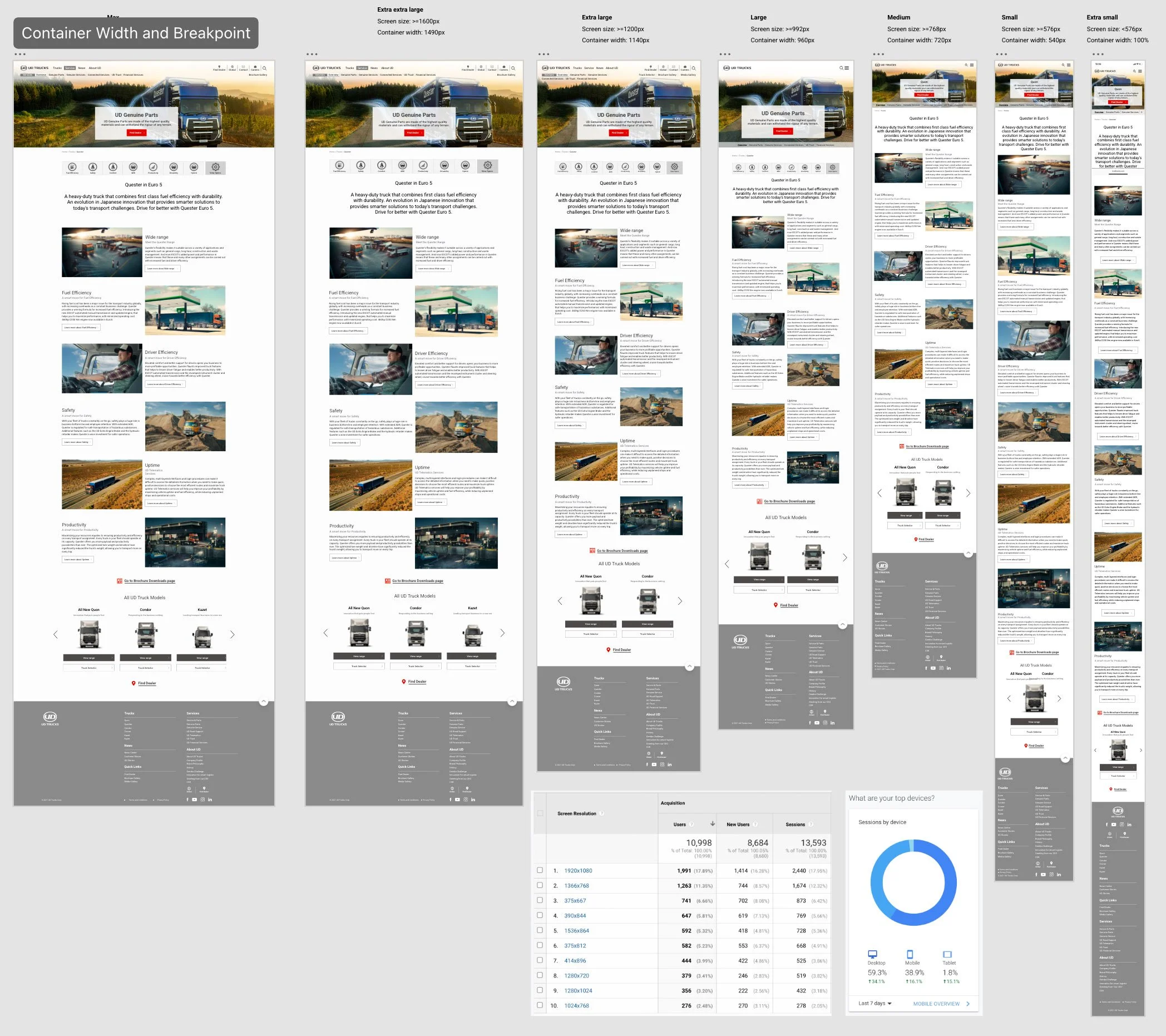
Containers and Breakpoints for 7 screen sizes of an earlier concept for page redesign along with top devices from Google Console.
Execution & Collaboration
In parallel with UX/UI design, I took on responsibilities beyond interface work to keep the project aligned across teams. This 19 Market site spanned over the course of a year, and needed all hands on deck with a small agency handling it.
This included:
Coordinating design direction between global stakeholders and internal teams
Supporting content migration and CMS structuring
Some examples included assisting with the migration of blogs across the 19 markets, which all had to be manually re-entered into new framework. As more hands were needed, during the QA process I had to help lead 5 other project managers to update content.
Writing detailed site manuals to ensure long-term usability
As we developed new features / modules, I was involved in the manual process as well, drafting as well as helping stakeholders learn how to commit new changes.
Assisting with CMS training to help regional teams adopt the new system
This cross-functional involvement helped reduce ambiguity, speed up decision-making, and ensure the final experience worked not just for users, but for the teams maintaining it.
Key Features: Interactive Dealer Locator
Designed for Global + Local Use
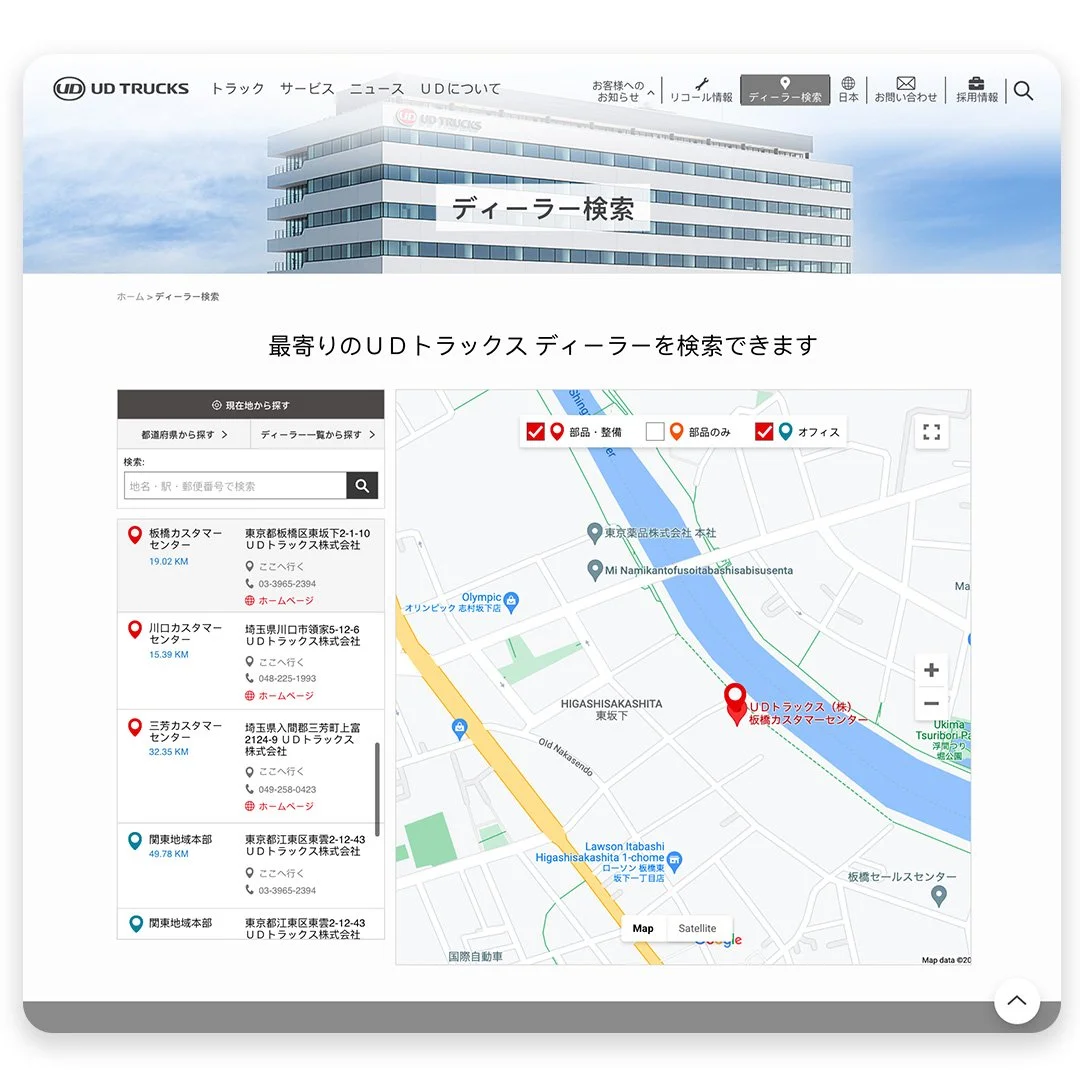
One of the most critical user journeys was helping customers quickly find the right dealer — especially for users on the road. After benchmarking leading automotive platforms, I redesigned the Dealer Locator as a dual-mode experience:
A searchable dealer list
An interactive map-based search
The new search flow was shaped by input from global stakeholders, in which the pin on the map would follow the depending their search entry. Additionally, as users might be on the road, I suggested adding in a “Search by Current Location” that would use the user’s current GPS position to find dealers around them.
Special attention given to the Japanese market, where the company is headquartered. To support local users, we integrated a custom Japanese map, and for on-the-go drivers, we added a “Search by Current Location” option using GPS to provide faster, more accurate results.

Key Features: Interactive Truck Selector For Cognitive Load Reduction & Quick Comparison
The Truck Selector tool was redesigned to support faster comparison and clearer decision-making.
I introduced a cleaner visual hierarchy, more prominent vehicle imagery, and a simplified layout that reduced visual fatigue when scanning options. These changes helped fleet managers and operators quickly identify models that matched their operational needs.
Human stories matter, even in industrial brands.
By emphasizing both the trucks and the people behind them, we reinforced the brand’s reliability and humanity. These visuals were integrated into a modernized interface that balanced technical credibility with approachability in Design Direction.
These visuals were integrated into an overall refreshed, modern design that elevated the overall look and feel of the site.
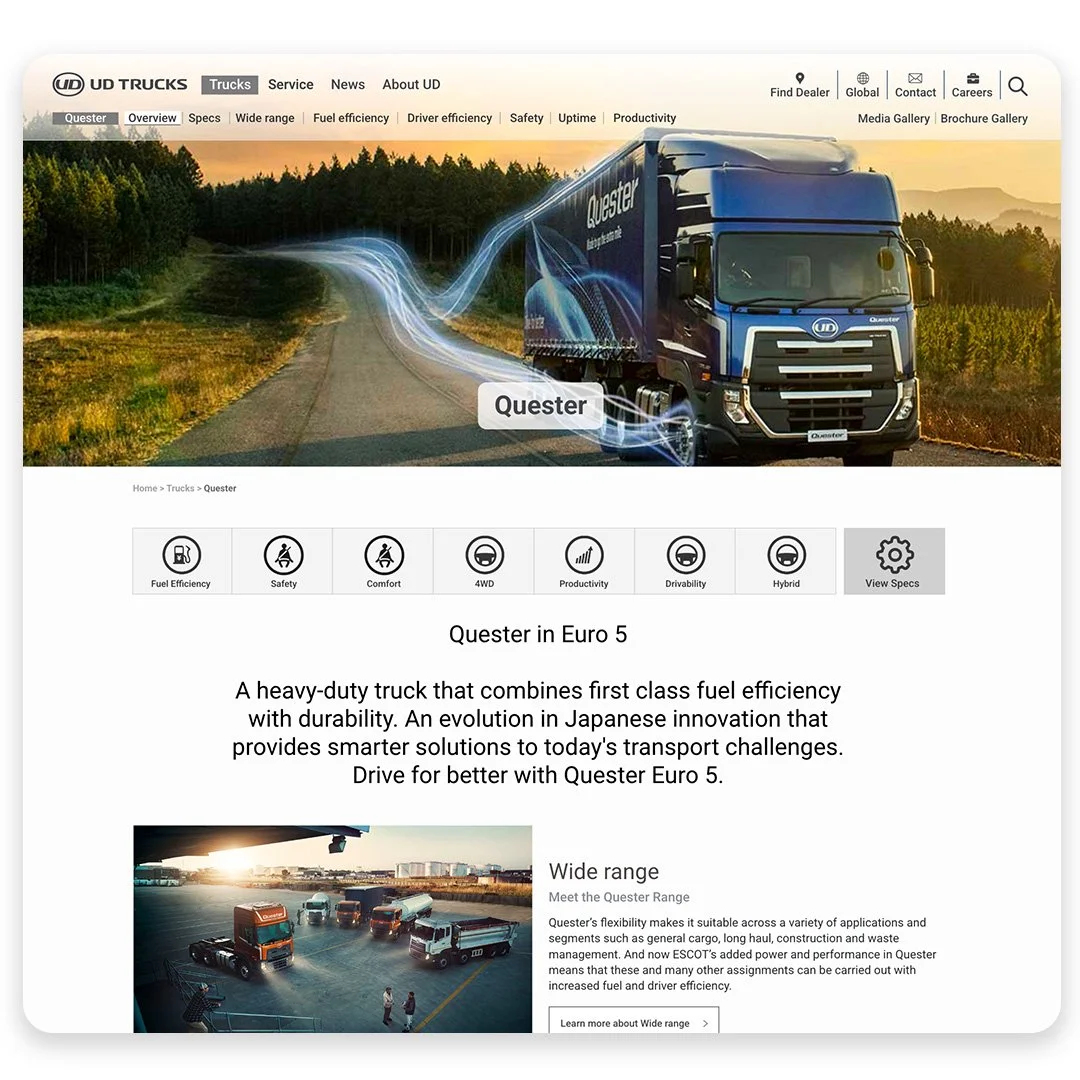
An updated secondary navigation was included to help visitors find the right information they need, from specs to fuel efficiency — saving time and organizing visibility.
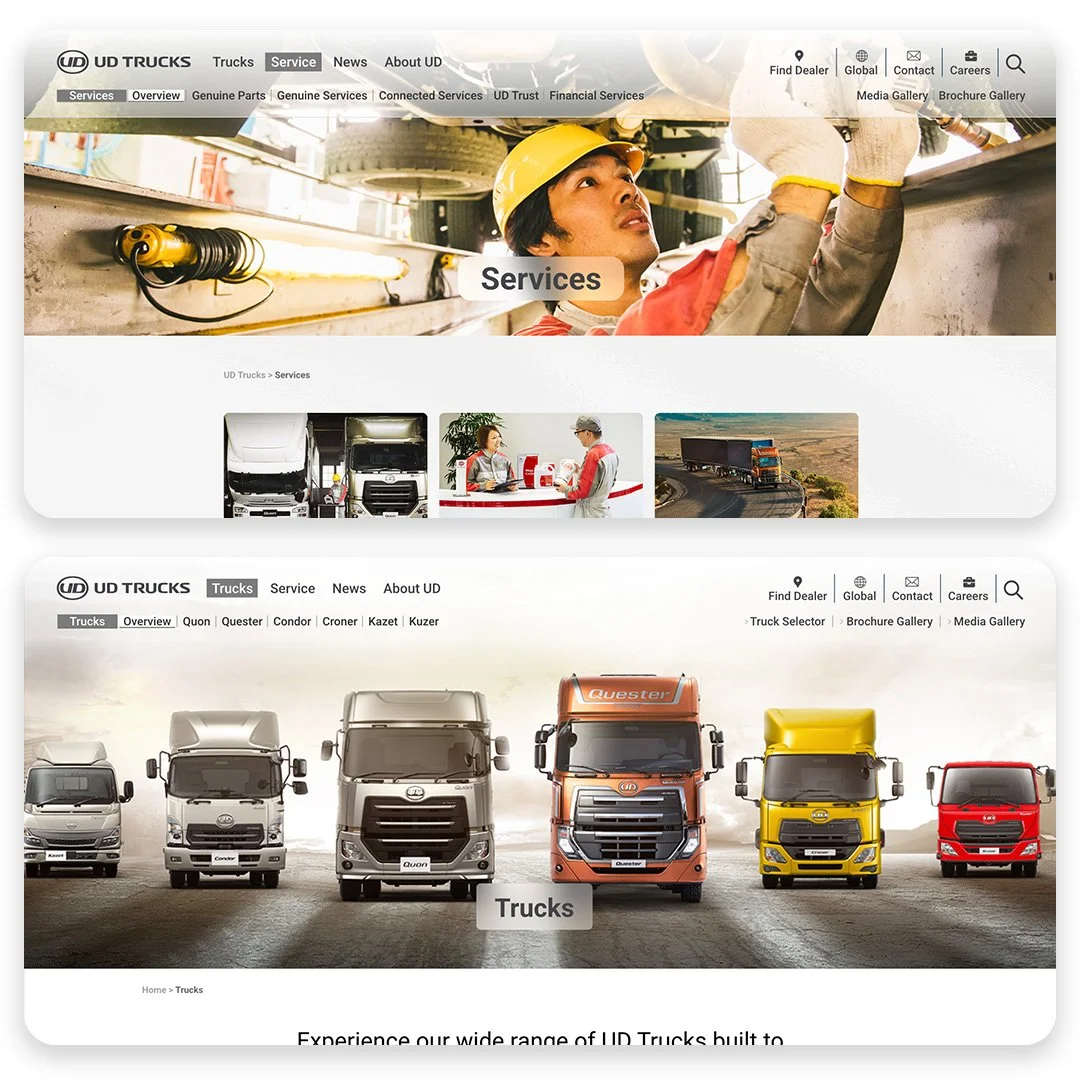
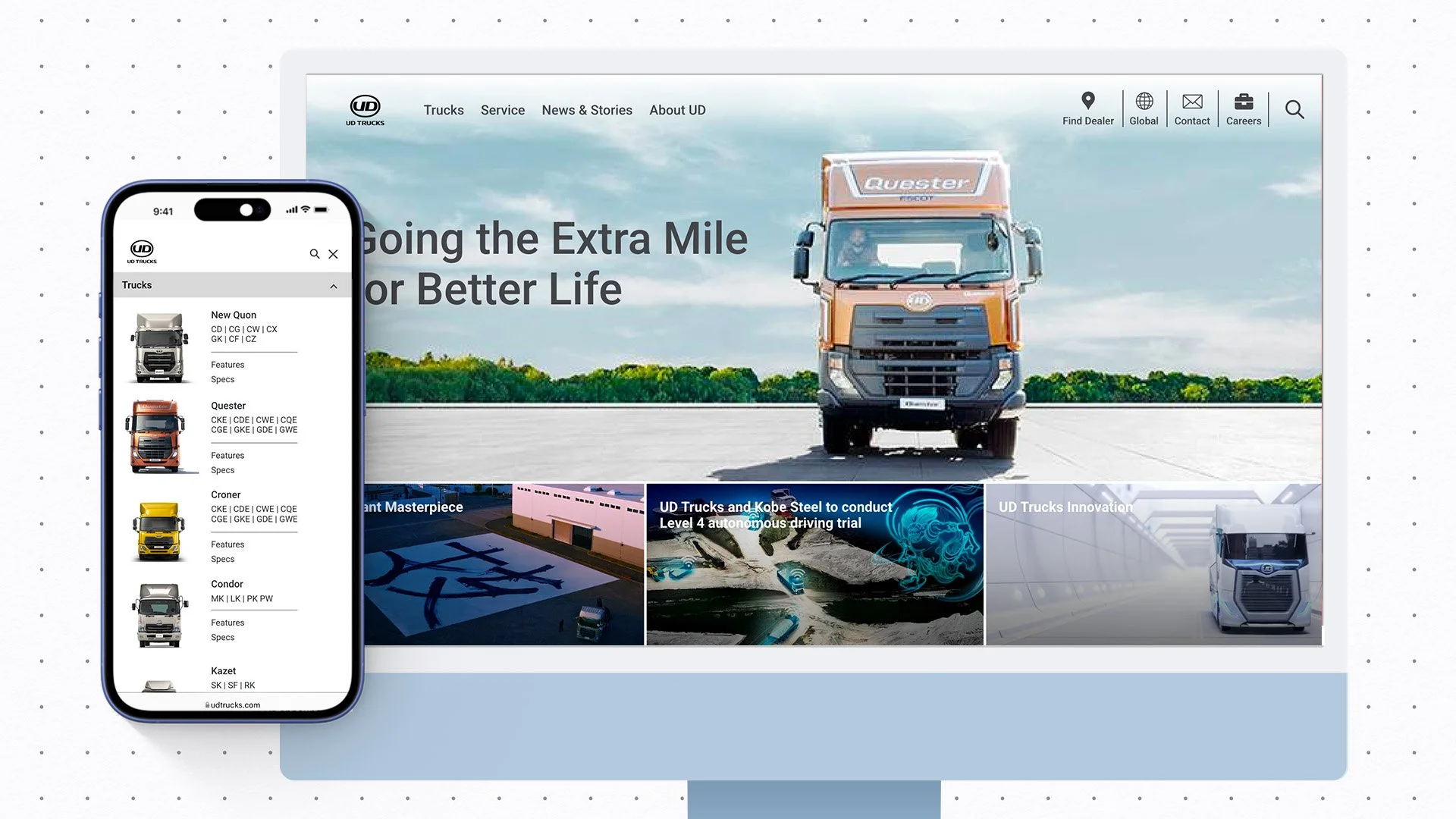
The top banners were given a unified look, highlighting key imagery from UD Trucks vast image library. Images were arranged to help tell a story rather than simply be there.
Cool greys, slight gradients and vivid imagery helped boost the premium feel. Iconography for buttons helped ease navigation, and were organized into design systems compared to what was previously used.
Additionally, care was given to the Truck page secondary navigation, where we introduced anchor links to help guide users to each of the truck’s feature as content was rich in descriptive SEO-ready text. A brochure download button to the right in the secondary navigation would lead to a form to help collect information while giving the industry visitor a guide to share with their operations team.
This project reinforced the value of scalable, human-centered design at an enterprise level.
Navigating a full CMS migration, global stakeholders, and a complete UX/UI overhaul pushed me beyond execution into leadership, systems thinking, and collaboration. It shaped how I approach large-scale digital platforms today — designing not just for launch, but for long-term use, growth, and ownership.