How a Japanese electronics brand with 200,000 units sold at home entered the American market — and what it actually took to build a commercial presence from zero.
THE SITUATION
Mirai Speaker had already won in Japan. Over 200,000 units sold. A patented curved panel technology that enhanced TV dialogue clarity for hard-of-hearing users — something no other speaker on the market did quite the same way. The product worked. The team believed in it. Japan was believing in it.
But the U.S. was a different challenge entirely.
No brand recognition. No reviews. No existing customer base. A product category still in its infancy in the U.S. A target audience — older adults struggling to hear TV dialogue — who don't respond to hype, don't trust easily, and return products the moment something feels off.
And two platforms to build simultaneously: a brand-owned eCommerce site and an Amazon storefront, both needing to work from day one.
I came in as the American design and strategy lead — the bridge between the Japan team and the U.S. market.
The ask was a U.S. brand site and an Amazon storefront. What became clear early was that neither would convert on presentation alone. The barrier wasn't price, it was unfamiliarity — every touchpoint had to teach before it could sell. That determined everything that followed.
COMMERCIAL OUTCOMES
CPA reduced 70% over four months — $263 to $79
Amazon CVR grew from 1.92% to 5.19%
202 brand site sales — monthly record (Black Friday 2024)
9.5 sales/day at $79 CPA — Black Friday peak
Ad performance tracked and managed by independent ad team.
Design, UX, and content systems contributed to these outcomes.
SCOPE DELIVERED
eCommerce (Brand Site + Amazon)
UX/UI Design & Direction
Content & Campaign Systems
Video Direction
A/B Testing & Optimization
CES Trade Show Debut
ROLE
Embedded Design & Strategy Lead (U.S. Team)
TEAM
Internal marketing director, U.S. expansion lead, PR / Ad Team, Customer Service Operations, Dev partner
CLIENT
Mirai Speaker. Tokyo, Japan.
TIMELINE
2023 — 2026
Visit miraispeaker.net
THE CHALLENGE
Three problems made this harder than a standard launch:
1. Category education before conversion. Mirai Speaker isn't a soundbar. It isn't a hearing aid. It's something new — and "something new" is the hardest thing to sell online to an audience that relies on familiar categories to make decisions. Every touchpoint had to teach before it could convert.
2. Trust for a skeptical demographic. Our primary buyer was an older adult, or their adult child shopping on their behalf. This audience reads reviews carefully, calls customer service, and returns products when they feel misled. Generic product marketing wouldn't work. Every claim had to be earned.
3. Two platforms, one coherent story. The brand site and Amazon needed to work as a system, not as two separate projects. A customer might discover us on Amazon and buy on the brand site. Or click a Meta ad, land on a landing page, and check Amazon reviews before purchasing. The experience had to hold across all of it.
WHAT WE BUILT
The Brand Site — soundfun.net
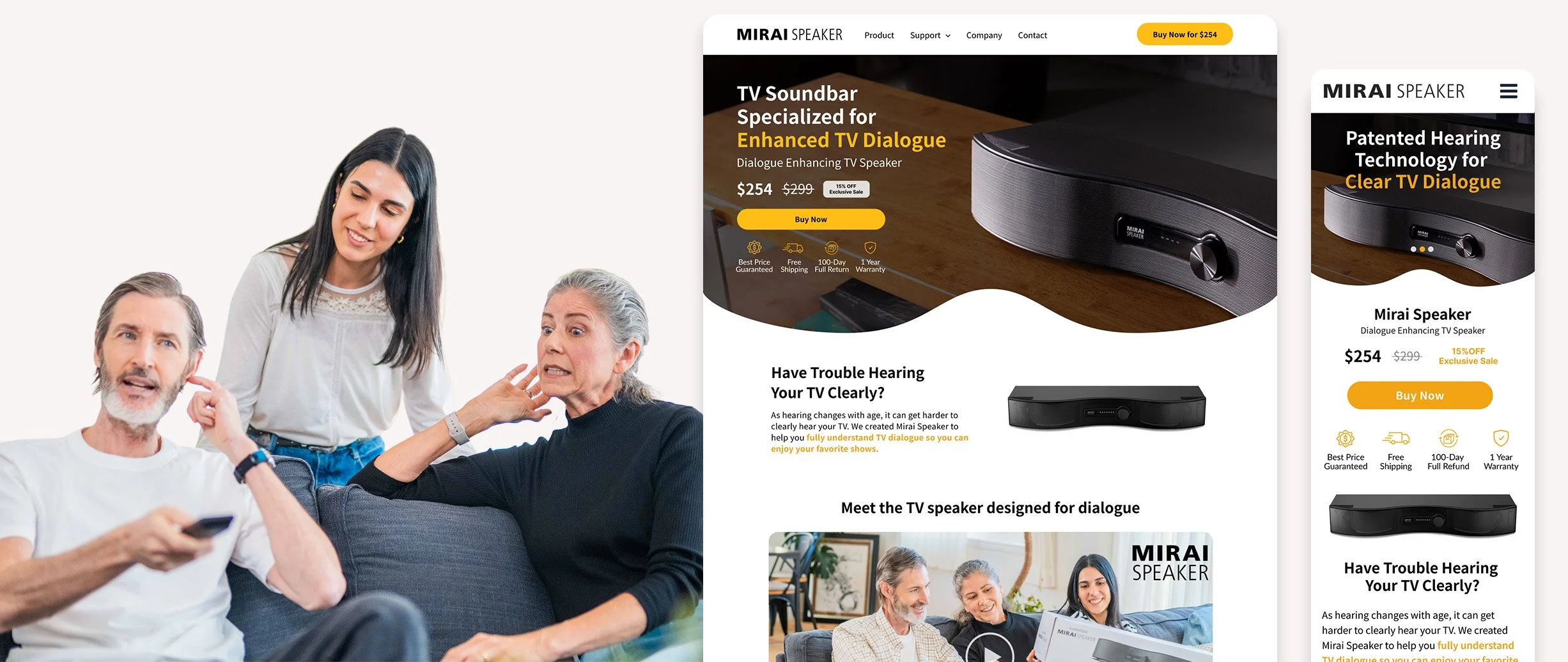
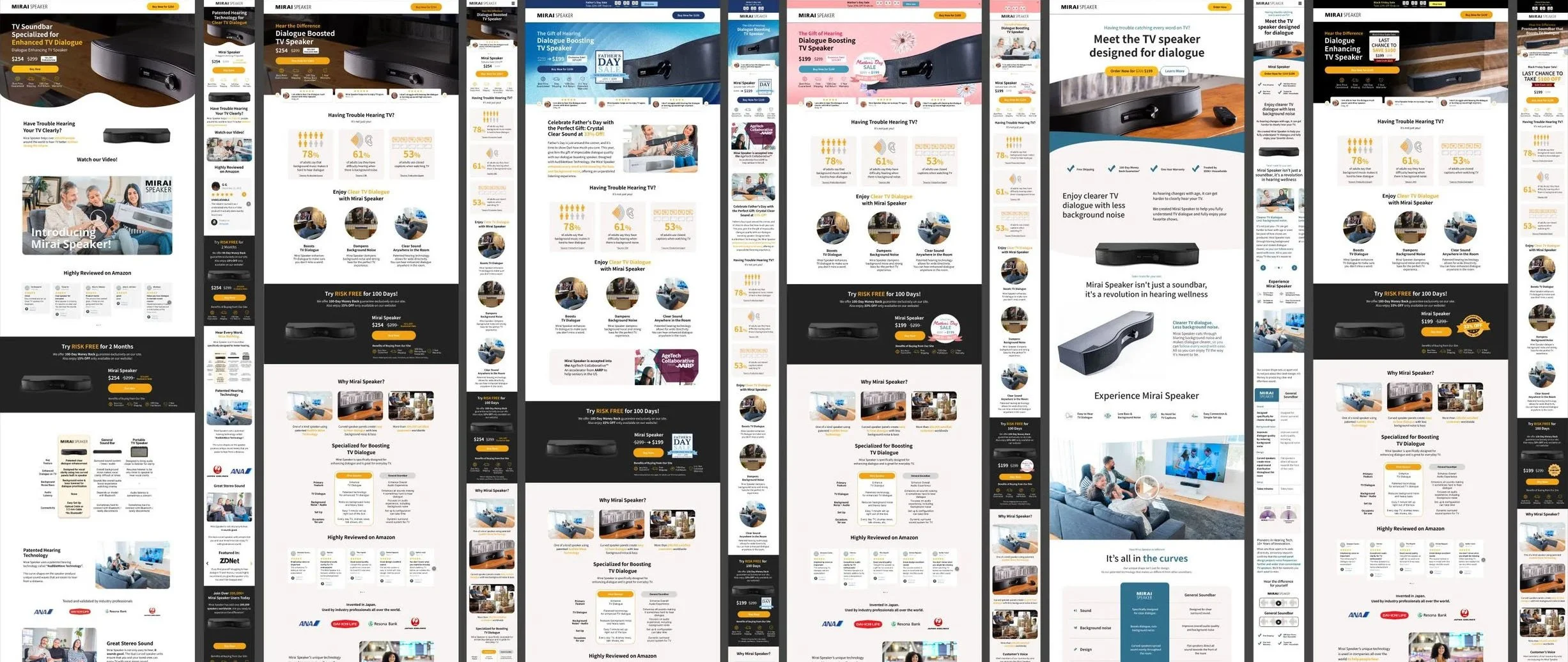
To carry that teaching load, the homepage was built as a modular system rather than a static page, letting us swap messaging, imagery, and offers between campaigns without rebuilding each time. A/B testing became fast and consistent as a result.
Sound is impossible to convey through copy alone. So we built an interactive comparison feature that let users hear the difference between standard TV audio and Mirai Speaker output before purchasing. It became the single highest-converting UX element on the site.
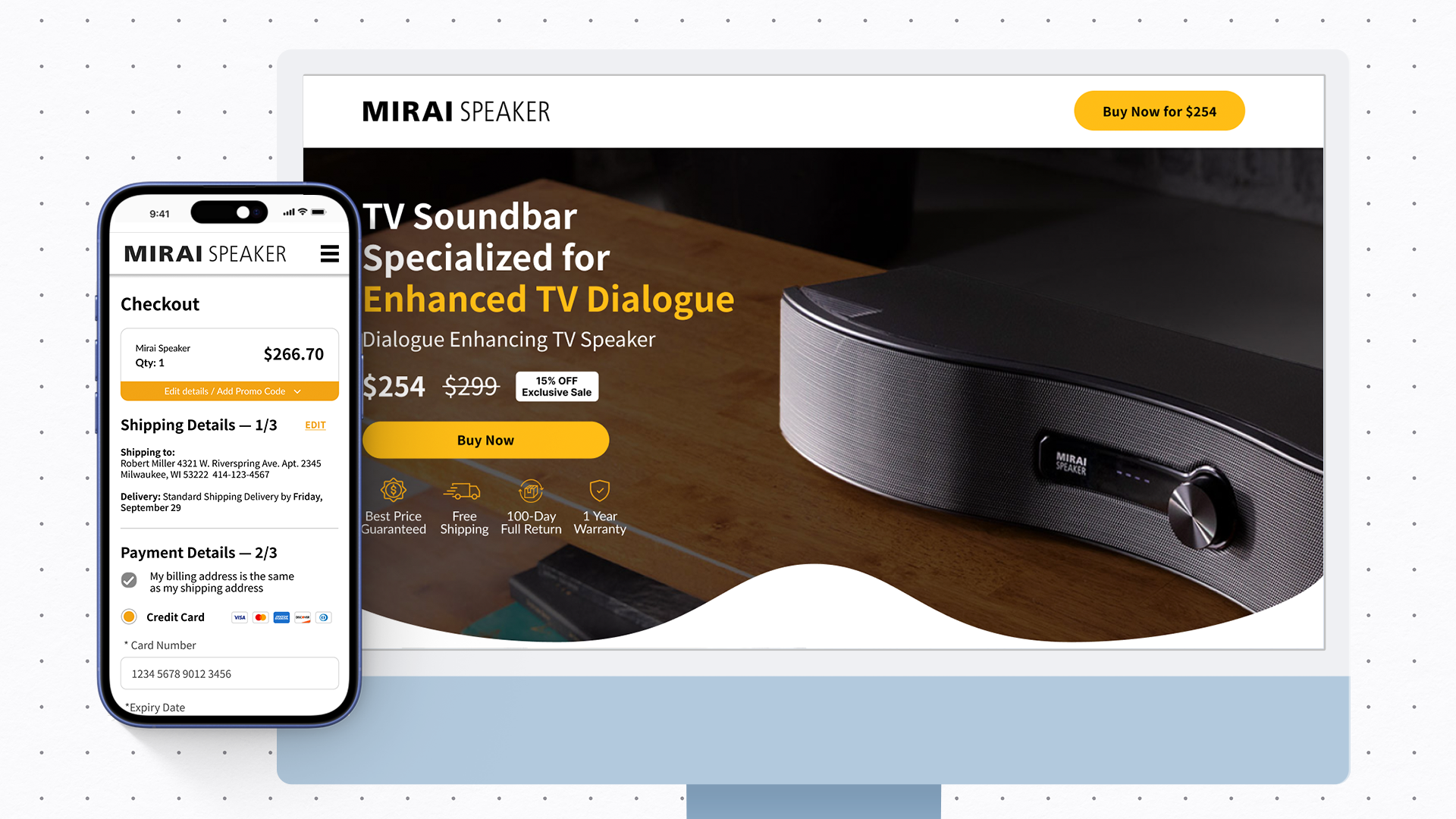
Checkout friction kills older demographics faster than any other audience. We simplified the flow to three steps and integrated Apple Pay, PayPal, and Amazon Pay — removing every unnecessary decision point before purchase.
Post-purchase confusion was driving returns more than product dissatisfaction. A dedicated support system was crucial here, so we added TV-specific setup guides, FAQ popups, and a searchable help center to help reduce that confusion and bring return rates down.
Additionally, email wasn't an afterthought. Klaviyo sequences were built into the funnel from day one: abandoned cart, post-purchase follow-up, re-engagement, and campaign-specific blasts tied to every major sale period.
Amazon — A+ Content & Storefront
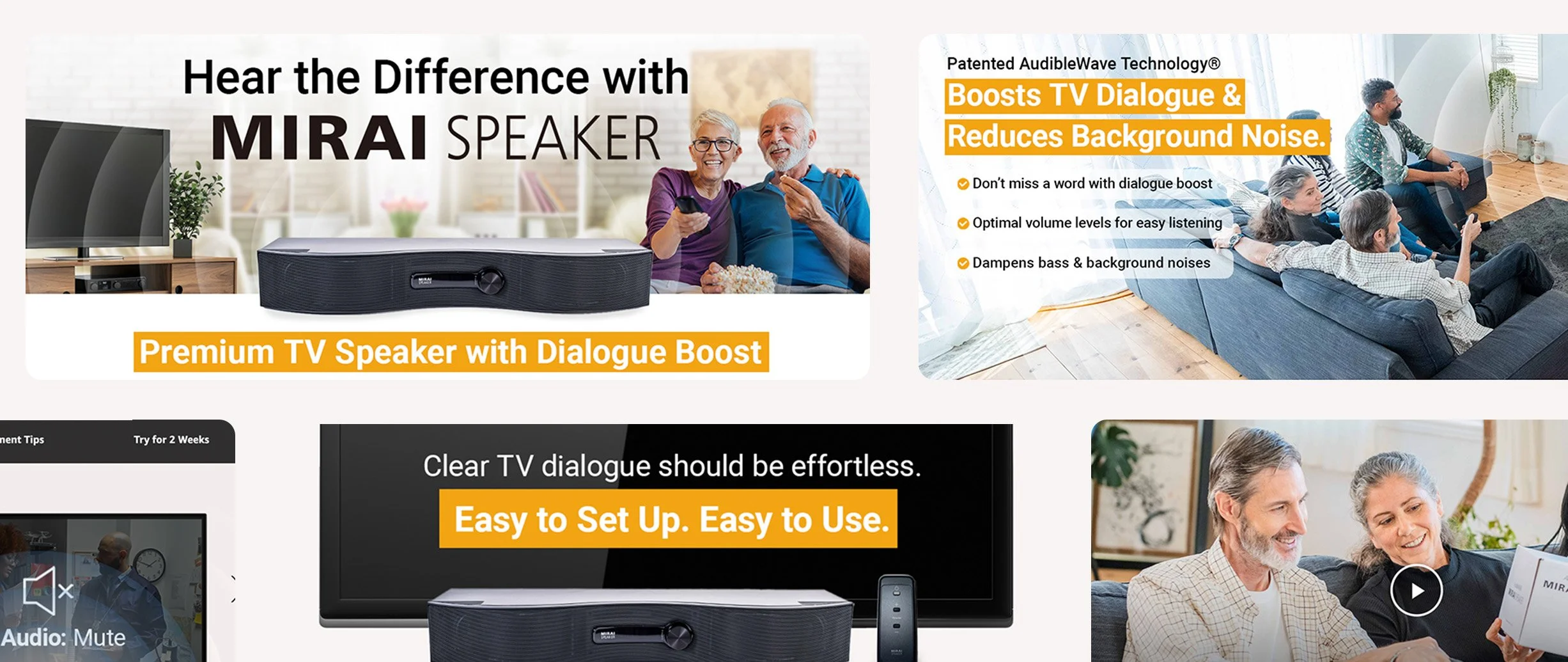
Most brands treat Amazon as a secondary channel — somewhere to list the product and hope the algorithm does the work. We didn't. From day one, Amazon was built as a co-primary platform alongside the brand site, with its own creative strategy and its own conversion logic.
Key decisions:
Amazon customers don't read — they scan and doubt within the competitive Amazon ecosystem.
The Premium A+ Content was built to answer the three questions that kill conversions before they happen: does this actually work, can I connect it to my TV, and what happens if it doesn't. Responsive layouts for desktop and mobile, video integration, comparison charts, connection guides, warranty information, and social proof — all structured around pre-purchase doubt, not only just showcasing product features.
The product imagery started generic and got sharper with every iteration. Image carousels, bullet points, and title copy were treated as conversion variables, not fixed assets — updated continuously as we learned what language and visuals moved people from browsing to buying.
Neither platform operated in a vacuum. When a landing page test on the brand site found a winning headline, we reflected it in Amazon copy. When Amazon CVR shifted, we looked at what had changed and why. The two platforms informed each other constantly — which is why the results moved together rather than independently.
Content, Video & Campaign Systems
Design and UX get people to the decision point. Content is what tips them over it. For a product nobody had heard of, targeting an audience that doesn't impulse-buy, content had to work harder than advertising. Every asset — every video, every static image, every email — was built to reduce a specific doubt or answer a specific question a potential buyer was carrying.
What we produced:
Directed video production for the sound comparison feature — developed with a videographer and the dev team. This became the most effective single UX element on the site, because it made the core product benefit something a user could experience rather than just read about.
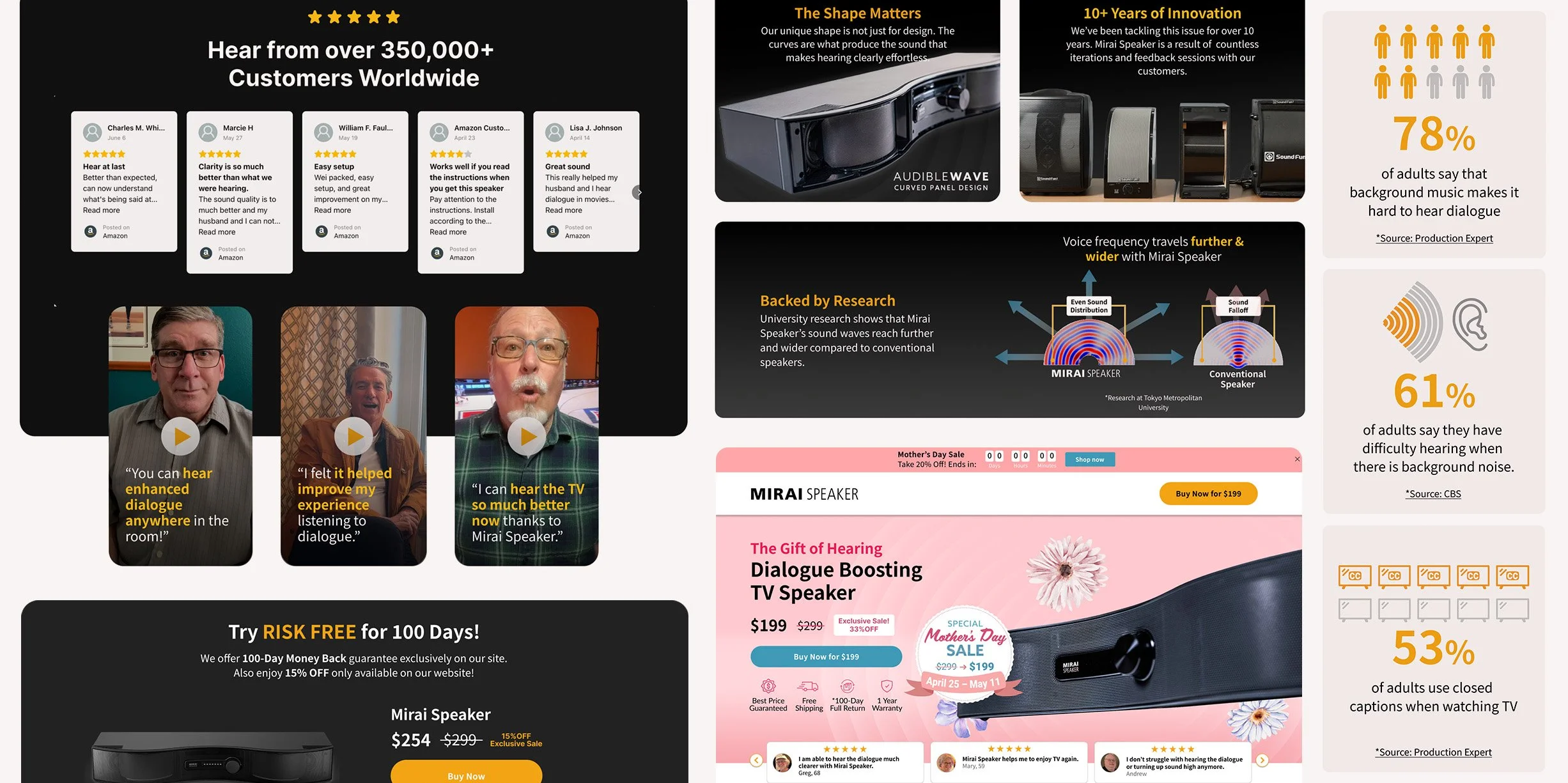
Led customer interview shoots in both Japan and the U.S. — coordinating logistics, developing questions, and directing the sessions. The footage was cut into testimonial content used across the site, social, and Meta.
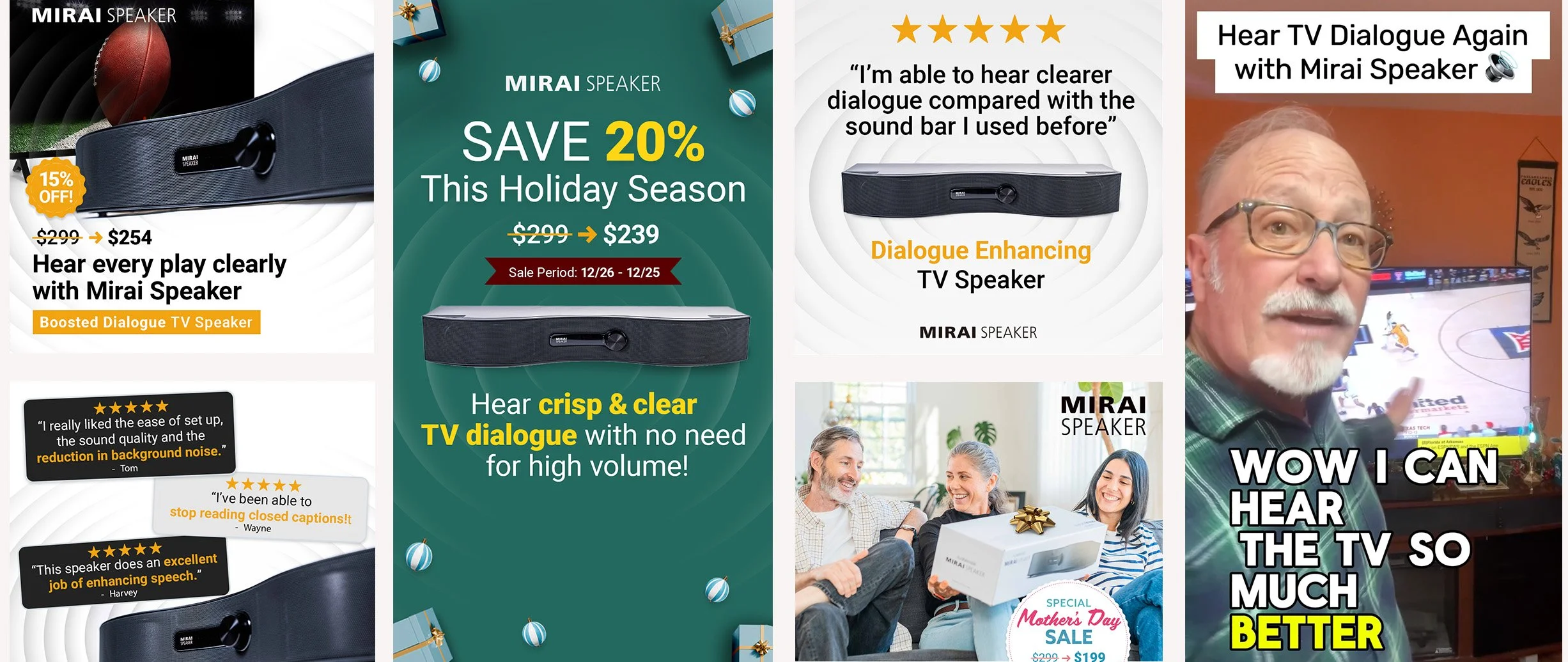
Directed and edited Billo UGC video ads for Meta and YouTube — scripting, talent briefing, and editing to platform specs. Billo ads consistently outperformed standard creative in CPA during the periods they ran.
Created 30+ static ad creatives tested across Meta, Google Display, and organic social — iterating in close collaboration with the ad team based on weekly performance data.
Designed all campaign assets across holidays such as Black Friday, Mother's Day, Father's Day, and Prime Day — along with countdown timers, sale banners, email headers, social graphics, and landing page variants for each period.
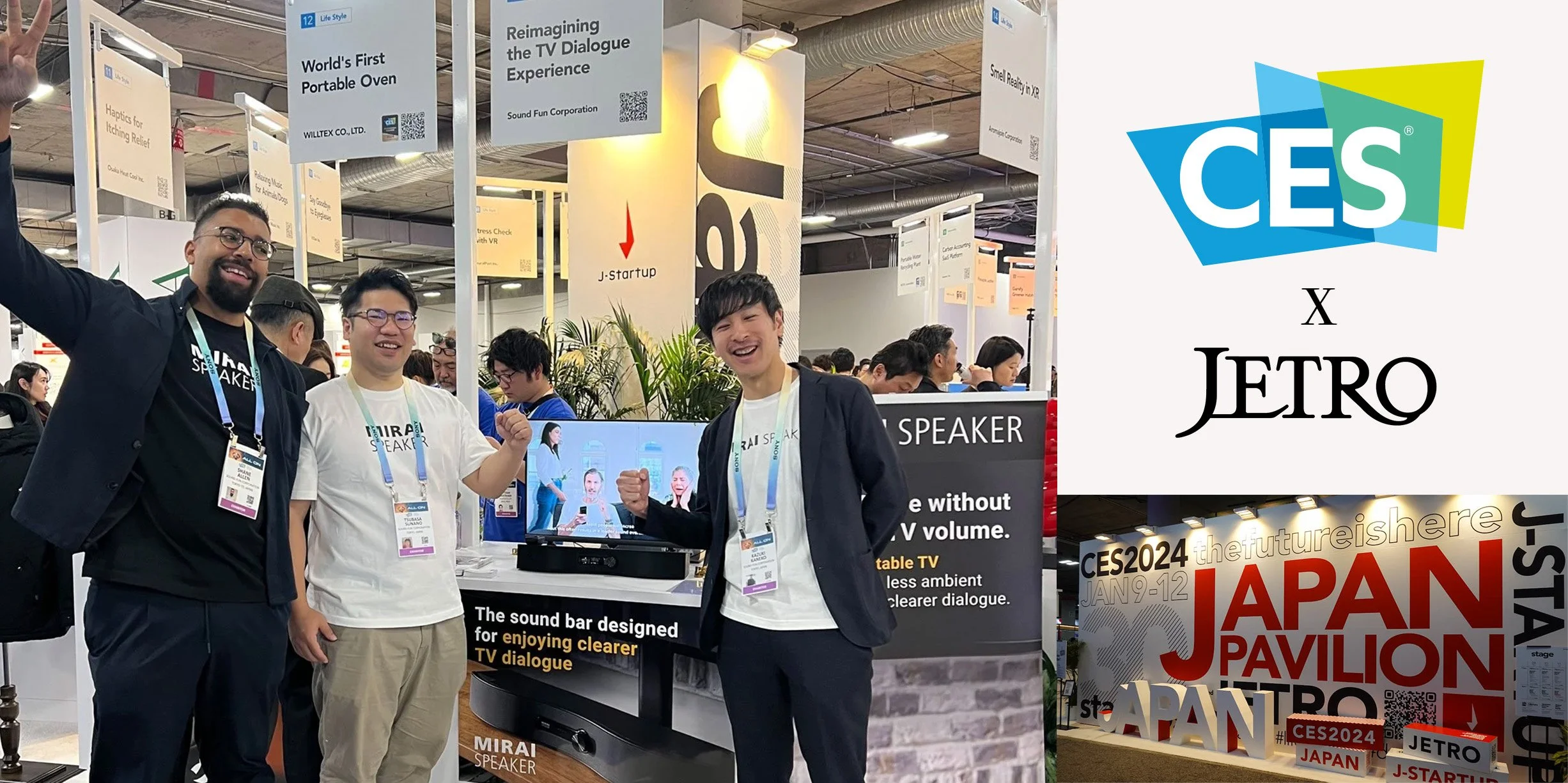
Produced brochures, packaging inserts, and trade show materials for the CES Las Vegas debut as a JETRO Japan Startup Program member.
A COLLABORATIVE EFFORT
This was a full team effort and it's worth saying that clearly.
I worked closely with Mirai Speaker's internal marketing director, U.S. expansion lead, and customer service team, alongside an Ad lead who managed Meta, Google, and Amazon campaigns and tracked the performance data that shaped every iteration. On the technical side, I brought in a development partner I'd worked with for years, operating through an agency, who handled the full site build.
Everyone had a lane. Everyone showed up and delivered — 120%
My lane was design direction and execution, consisting of: UXUI, content, and the visual and digital build across both platforms. The cross-cultural translation was the specific thing I was there to do: making sure what we built would actually land with an American audience the Japan team couldn't fully see from Tokyo. That meant weekly calls bridging both sides, fast decisions when things needed to change, and the ability to hold coherence across every touchpoint simultaneously without losing the thread.
No single person built this. But someone had to make it make sense across all of it. That was the job.
WHAT HAPPENED
The commercial results were tracked by the independent ad team across both platforms through continuous iteration.
CPA dropped from $263 (July 2024) to $79 during Black Friday — a 70% reduction over four months, driven by landing page optimization, creative iteration, and a conversion system that got tighter with every campaign cycle. Launch CPA (November 2023) was $255 — meaning acquisition efficiency was still improving a full year into the engagement, not just during an initial optimization push.
Amazon CVR grew from 1.92% (July 2024) to 5.19% (January 2025) — the result of continuous A+ Content improvement, title and copy optimization, and review accumulation over time.
The brand site peaked at 202 sales in a single month — a record set during Black Friday 2024, more than 12x the brand site's launch-month volume.
Best single sale performance: 9.5 sales/day at $79 CPA during Black Friday. Mother's Day followed at 7.5 sales/day at $83 CPA — better efficiency than the prior year's comparable period.
Return rates came down meaningfully after the support page, connection guide system, and FAQ infrastructure were in place — confirming that a significant portion of early returns were confusion-driven, not product-driven.
The brand debuted at CES Las Vegas as a JETRO Japan Startup Program member — connecting with U.S. press, buyers, and the broader tech ecosystem in person for the first time.
Whether the results came from the ads, the UX, the content, or the combination — the system made them possible.
“Good market entry work doesn't just sell product. It tells you what the product needs to become.”
WHAT THIS REINFORCED
Taking a product to a new market is larger than design.
The design, the UX, the content, the copy, the support infrastructure — all of it exists to answer one question a stranger is silently asking: "Can I trust this enough to truly help my condition, let alone spend my money on it?"
Getting that answer to land consistently — across a brand site, an Amazon storefront, a video ad, a packaging insert, and a customer service email — is the actual work. Not the deliverables. The coherence across all of them.
That's what cross-cultural market entry requires. And it's the work I'm built for.
The U.S. launch ultimately informed a product development decision. Mirai Speaker paused U.S. sales to incorporate market learnings into the next generation of the speaker. The conversion data, the return reasons, the customer feedback, the review patterns — the system we built generated all of it. Good market entry work doesn't just sell product. It tells you what the product needs to become.
Testimonial
My name is Kaneko, and I serve as CMO at Mirai Speaker Inc. Over the past two years we have worked together on the U.S.-facing D2C business. Shane was responsible for the overall direction of creative work — including the design of advertisements and landing pages — as well as the production of various materials used at trade shows. He also participated in overseas exhibitions including CES, where he played an important role in on-site attendance and support.
What I particularly want to highlight is his ability to deliver high-quality creative with speed. This enabled the rapid iteration cycles essential to our D2C business and made a significant contribution to both business growth and performance improvement. He also demonstrated strong communication skills, which proved to be a major asset in facilitating smooth coordination both within and outside the team. For these reasons, I strongly recommend Shane as an outstanding business professional.
(Original Japanese)
私は、ミライスピーカー社にてCMOを務めております金子と申します。現職においては約2年間、米国向けD2C事業において共に業務に取り組んでまいりました。同氏は、広告やLPのデザインを含むクリエイティブ全般のディレクションに加え、展示会で使用する各種制作物の作成を担当しておりました。また、CESをはじめとする海外展示会にも参加し、現地でのアテンド業務においても重要な役割を果たしていました。特に評価すべきは、クオリティの高いクリエイティブをスピード感を持って提供できる点です。これにより、D2C事業において不可欠な高速なPDCAサイクルを実現し、事業成長および業績改善に大きく貢献しました。さらに、高いコミュニケーション能力を備えており、チーム内外の連携を円滑に進める上でも大きな強みを発揮していました。以上の理由から、シェーン氏を優れたビジネスパーソンとして強く推薦いたします。
— Kazuki Kaneko, MIRAI SPEAKER Inc. CMO
CarmelloVision is a Tokyo-based digital partner for companies expanding between Japan and global markets. Founder Shane Allen combines cross-cultural UX strategy, design execution, and over a decade of experience working inside Japanese and global teams to help brands navigate unfamiliar markets and build meaningful connections across cultures.
Taking a product across markets?
Japan to global, or global to Japan — this is what CarmelloVision is built for. If you're planning a launch, a localization, or a full rebuild, let's compare notes. Two sentences is plenty. I reply within one business day.